
As data center networks continue to scale in bandwidth and reach, 40G Ethernet remains a critical building block for aggregation and backbone connectivity. Among the various 40G optical solutions, parallel single-mode transmission has become an attractive option for scenarios that require longer reach without the complexity of wavelength multiplexing. In this context, 40G QSFP+ modules based on the PSM4 standard offer a unique balance between performance, cost, and architectural simplicity, making fiber interconnect design a key factor in overall network reliability.
Unlike traditional duplex fiber solutions, 40G QSFP+ modules using the 40GBASE-PSM4 specification rely on parallel optical lanes and MTP/MPO connectivity. This architectural shift means that successful deployment is no longer determined solely by the transceiver itself, but by how well the fiber infrastructure is designed to support parallel transmission. A well-planned MTP/MPO interconnect is essential to fully unlock the advantages of PSM4 modules while avoiding common pitfalls during installation and operation.
Understanding the Interconnect Requirements of 40GBASE-PSM4
The 40GBASE-PSM4 standard transmits data over four parallel single-mode fiber pairs, each operating at 10 Gbps using a 1310 nm wavelength. These four lanes work simultaneously to deliver an aggregated bandwidth of 40 Gbps over distances of up to 10 km. Because each lane operates independently, signal integrity depends heavily on consistent fiber quality and precise alignment across all channels.
To support this parallel architecture, QSFP+ PSM4 modules use MTP/MPO connectors, typically with a 12-fiber configuration. Eight fibers are actively used for transmission and reception, while the remaining fibers are reserved or left unused. This design simplifies long-distance 40G transmission compared to LR4 solutions, but it places greater emphasis on proper fiber management and interconnect planning.
The Role of MTP/MPO Fiber in PSM4 Architectures
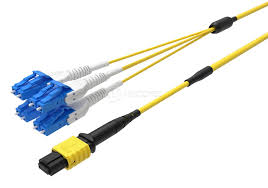
MTP/MPO fiber connectors are the foundation of parallel optical systems. Their ability to terminate multiple fibers within a single compact interface makes them ideal for high-density environments such as data centers. In a 40GBASE-PSM4 deployment, the MTP/MPO interface ensures that all four transmit and receive lanes are connected simultaneously, reducing the need for complex fan-out cabling.
However, this advantage also means that any issue affecting one fiber—such as excessive insertion loss or contamination—can degrade the entire link. For this reason, MTP/MPO solutions used with PSM4 modules are typically based on single-mode fiber optimized for 1310 nm transmission, ensuring consistent performance across all channels over extended distances.
Polarity Design: A Critical Factor in Parallel Optical Links
Polarity is one of the most critical and commonly misunderstood aspects of MTP/MPO interconnect design. In a parallel optical system, each transmit lane on one end must align precisely with the corresponding receive lane on the other end. Incorrect polarity can result in link failures that are difficult to diagnose, especially in large-scale deployments.
For 40GBASE-PSM4 links, proper polarity management ensures that the four transmit fibers from the QSFP+ module are correctly mapped to the four receive fibers on the remote module. Selecting the appropriate polarity method—such as Type A, Type B, or Type C—depends on the overall cabling architecture and the use of patch panels or trunk cables. A consistent polarity strategy across the entire fiber infrastructure is essential for minimizing troubleshooting and deployment time.
Fiber Link Planning for 10 km Transmission
Although 10 km is well within the capability of PSM4 modules, achieving stable performance at this distance requires careful attention to link loss budgets. Insertion loss from connectors, splices, and patch panels can accumulate quickly in MTP/MPO-based systems, making link planning a crucial design step.
High-quality trunk cables, low-loss MTP/MPO connectors, and minimized connection points all contribute to better signal margins. In addition, maintaining consistent fiber lengths and avoiding unnecessary bends helps ensure uniform optical performance across all four lanes. These considerations are especially important in data center interconnect and campus backbone applications, where long-term stability is a priority.
Comparing PSM4 Interconnect Design with Other 40G Solutions
Compared with 40GBASE-SR4, which relies on multimode fiber and short-reach transmission, PSM4 offers significantly longer distances while maintaining a similar parallel fiber architecture. This makes PSM4 particularly suitable for inter-building or extended data center links where multimode solutions are no longer practical.
When compared to 40GBASE-LR4, PSM4 avoids the complexity of wavelength division multiplexing by using parallel fibers instead of multiple wavelengths on a single fiber pair. From an interconnect design perspective, this reduces transceiver complexity but shifts more responsibility to the fiber infrastructure itself. The choice between these solutions often depends on existing cabling, required reach, and long-term scalability.
Best Practices for Deployment and Maintenance
Successful deployment of 40GBASE-PSM4 links depends not only on design but also on execution. Proper cleaning and inspection of MTP/MPO connectors are essential, as contamination can affect multiple lanes simultaneously. Testing parallel links during installation helps identify lane imbalance or excessive loss before the network goes live.
Ongoing maintenance should include periodic inspection of fiber connections and verification of link performance. By combining disciplined operational practices with a well-designed interconnect architecture, organizations can ensure that their 40G PSM4 links remain stable and reliable over time.
Conclusion
MTP/MPO fiber interconnect design plays a decisive role in the performance of 40GBASE-PSM4 QSFP+ deployments. By understanding the parallel nature of PSM4 transmission and carefully planning polarity, fiber quality, and link loss, network designers can fully leverage the advantages of this 40G solution. When properly implemented, PSM4-based 40G networks deliver a scalable, efficient, and robust foundation for modern data center connectivity.