
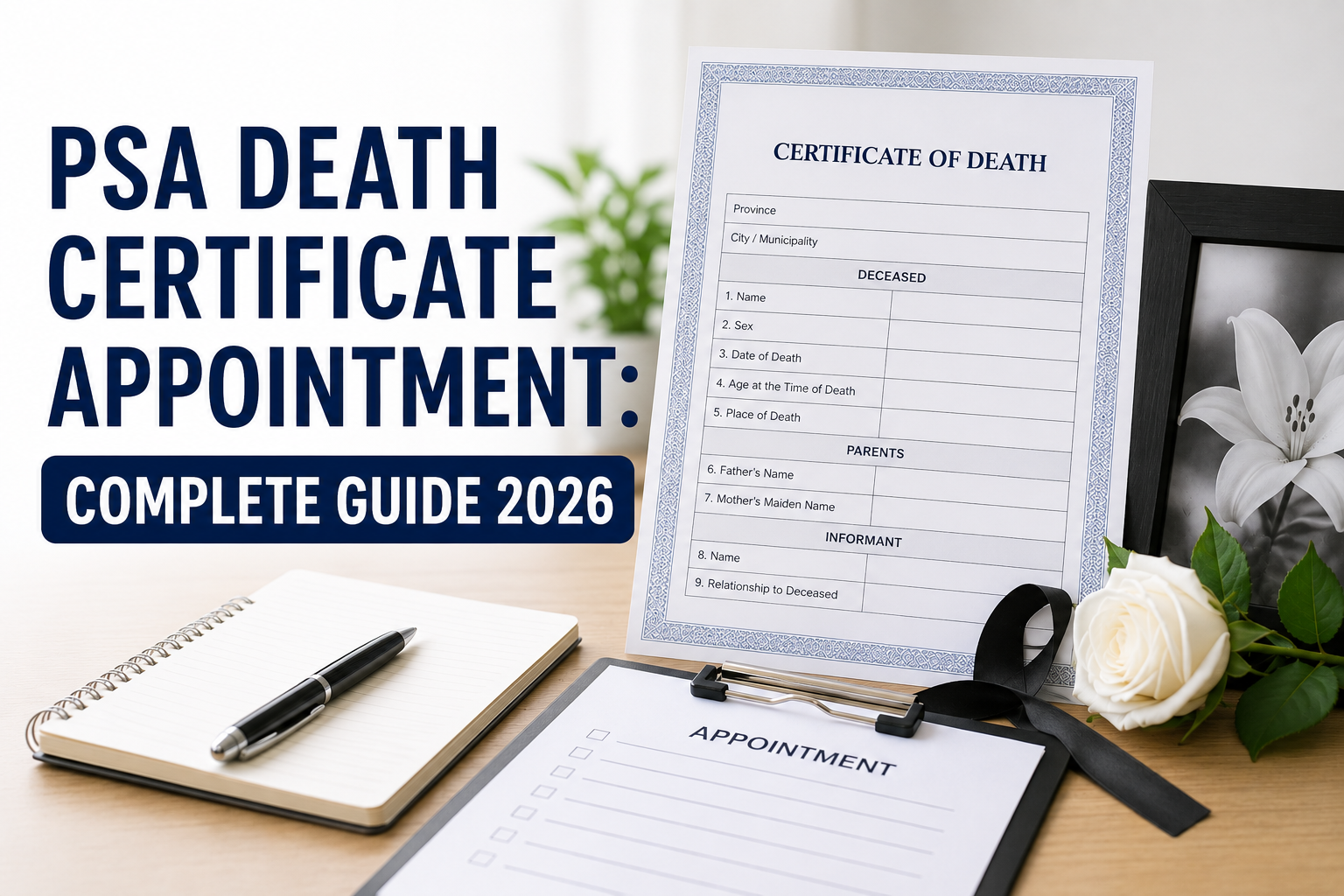
When a loved one passes away, administrative tasks are the last thing anyone wants to think about yet several legal and financial processes cannot proceed without an official copy of the death certificate. Whether you need it for estate settlement, insurance claims, pension processing, or updating government records, the document must come from the national civil registry authority and must be the authenticated copy on official security paper. Requesting it requires either a scheduled visit to a civil registration outlet or a remote request through the appropriate government channel. This guide explains exactly how to book a psa appointment online for a death certificate in 2026, what documents to bring, what to expect at the outlet, and what to do when the record cannot be found.
What Is a PSA Death Certificate and When Is It Required
A death certificate issued by the national civil registry authority is the official government record that a death occurred, documenting the deceased person’s full name, date and place of death, age, civil status, and other relevant details. This document is distinct from a locally issued death certificate while both are used in different contexts, the nationally authenticated copy on security paper is required for the most significant legal and financial transactions.
Common situations that require an official death certificate:
- Estate settlement and inheritance proceedings courts and legal proceedings require the official death record to establish that the deceased has passed and to initiate succession processes
- Insurance claims life insurance policies typically require an official death certificate before a claim can be processed and paid out
- SSS, GSIS, or pension benefit claims surviving spouses and dependents need the death certificate to claim death benefits or surviving spouse pensions
- Bank account closure or transfer financial institutions require official documentation before releasing funds from a deceased person’s accounts
- Land title and property transfers the death certificate is needed as part of the documentary chain for transferring registered property from a deceased owner
- Marriage annulment or subsequent marriage a surviving spouse who wishes to remarry may need to present the death certificate as documentary evidence
- Cancellation of government-issued IDs and records updating or cancelling the deceased’s national ID, voter registration, or other records typically requires the death certificate.
Who Can Request a Death Certificate
Civil registry documents are generally accessible to the following parties:
- Immediate family members spouse, children, parents, and siblings of the deceased
- Legal representatives attorneys or authorized agents acting on behalf of the estate or family, with appropriate documentation
- Authorized representatives any person holding a valid authorization letter from an immediate family member, accompanied by appropriate identification
- Government agencies authorized government offices that require the document in the course of official proceedings
If you are not an immediate family member or legal representative, you will need an authorization letter from someone who qualifies, along with a photocopy of that person’s valid identification document.
Step 1: Gather the Deceased’s Personal Information
Before booking or placing any request, confirm that you have accurate details about the deceased. The civil registry database search at the outlet counter depends entirely on the information you provide and a single error can prevent a successful match even when the record genuinely exists.
Information you will need:
- Full legal name of the deceased first, middle, and last name as registered
- Date of death day, month, and year
- Place of death city or municipality and province where death occurred and was registered
- Date of birth of the deceased helpful for narrowing the search when names are common
- Age at time of death as a cross-reference detail
Cross-reference these details against an existing local death certificate, medical certificate of death, or any document prepared at the time of death before submitting them as search criteria.
Step 2: Decide Between an In-Person Appointment and a Remote Request
For requesting a death certificate, there are typically two available pathways: an in-person visit to a civil registration outlet with a confirmed appointment, or a remote request through an official online ordering channel with home delivery. Understanding which suits your situation prevents unnecessary delays.
An in-person appointment is better if:
- You need the document on the same day
- The death occurred recently and you are uncertain whether the record is yet available in the central database
- You want to speak directly with staff about a record that may require special handling
- You have reason to believe the record may need an alternative search
A remote online request is better if:
- You do not live near a civil registration outlet
- You are comfortable waiting a few business days for delivery
- You are requesting on behalf of a family member who is abroad
- No appointment slots are currently available at nearby outlets
This guide focuses primarily on the in-person appointment pathway, with the remote option addressed in a later section.
Step 3: Book Your Civil Registration Appointment
Appointments for death certificate requests follow the same booking process as appointments for birth certificates and marriage certificates through the official civil registration booking platform.
Preparation Before Booking
Have the following ready before opening the booking form:
- Your own full name (the requester’s name, not the deceased’s)
- An active mobile phone number where you can receive a one-time verification code
- A personal email address preferably a personal account rather than a work or school email, since automated government system messages are frequently filtered into spam by institutional email servers
The Booking Process
- Open the official civil registration appointment platform by typing the correct address directly into your browser
- Select the option to book a new appointment
- Read and accept the data privacy notice mandatory before proceeding
- Choose your preferred civil registration outlet any outlet nationwide can process death certificate requests, regardless of where the death occurred or where the family lives
- Select “Death Certificate” as the document type
- Choose whether you are requesting for yourself (as a family member) or on behalf of another authorized person
- Select an available date and time from the calendar choose a slot that gives you enough time to prepare all required documents
- Enter your full name, mobile number, and email address check each field carefully before submitting
- Complete the human verification step and click submit
- Enter the one-time verification code sent to your mobile number promptly these codes expire after a few minutes
- Save the booking confirmation screenshot the entry code and check your email for the confirmation message immediately.
Step 4: Documents to Bring to Your Appointment
Arriving at the outlet with complete documentation ensures the transaction is completed in a single visit.
If You Are an Immediate Family Member Requesting in Person
- Appointment confirmation with the entry code (phone screenshot or printed)
- One original valid government-issued identification document
- One clear photocopy of that identification document
- The processing fee in cash prepare small bills or exact change
Commonly accepted identification documents:
- National identification card
- Passport
- Driver’s licence
- Unified multi-purpose identification card
- Voter’s identification
- Senior citizen identification card
- Disability identification card
- Professional licence card
If You Are an Authorized Representative
In addition to your own identification, bring:
- A signed authorization letter from the requesting family member specifying your name, your relationship to the authorizing party, and the specific document being requested
- A photocopy of the authorizing family member’s valid identification document
- Your own original valid identification document
- A photocopy of your own identification document
The authorization letter does not require notarization for standard civil registry requests, but it must carry the physical handwritten signature of the authorizing party; a typed name alone is not sufficient.
Step 5: At the Civil Registration Outlet
Arrive at least 15 minutes before your scheduled time slot. Present your entry code at the information desk or to the staff member stationed near the entrance. Senior citizens, persons with disabilities, and pregnant individuals are entitled to priority lane access and inform the staff member of this at the entrance.
When your number is called at the counter, the staff member will ask for the deceased’s personal details to search the civil registry database. Provide:
- Deceased’s full legal name
- Date of death
- Place of death (city or municipality and province)
- Date of birth (as a cross-reference if needed)
If the record is found, the death certificate is printed on official security paper and sealed. You pay the processing fee at the counter and receive the document during the same visit.
Step 6: What to Do When the Record Cannot Be Found
“No record found” is one of the most common outcomes for death certificate requests and it is important to understand that it does not necessarily mean the death was not registered. There are several potential explanations.
The Death Was Registered Recently
After a death is registered at the local civil registry, the record takes time to be transmitted, verified, and encoded into the national civil registry database, a period sometimes called the posting period. This posting period can range from several weeks to several months, depending on the local civil registry’s transmission schedule and the area where the death occurred.
If the death was registered within the past six months or less, the record may simply not yet be in the national database. In this case:
- Request a locally issued death certificate directly from the local civil registry office of the place of death as an interim document
- Wait for the posting period to elapse before attempting the national registry request again
The Death Was Registered Under Different Information
The search may fail if the information you provided does not closely match what was recorded, a different spelling of the name, the wrong date, or the wrong municipality. Ask the staff to attempt alternative searches with slight variations in the search criteria.
The Death Was Never Formally Registered
For older deaths particularly in rural areas or during periods of historical disruption it is possible that the death was never registered with the local civil registry. In this case, a late death registration may be required at the local civil registry office in the place of death before the national civil registry can issue a copy.
The Record Exists but Requires Manual Retrieval
For deaths registered many years ago particularly before widespread digitization the record may exist only in paper or microfilm archives and has not yet been encoded into the digital database. In this situation, the outlet staff will advise you on the process for requesting manual retrieval, which typically adds several weeks to the overall timeline.
Step 7: The Online Request Option
If booking an in-person appointment is not practical either because available slots are fully booked at nearby outlets or because you prefer home delivery a remote online request is available through the official online civil registry ordering channel.
How the online request works:
- Submit the deceased’s personal details through the official online ordering platform
- Choose a delivery address within the Philippines where an authorized recipient will be available to receive the package
- Pay through an accepted digital payment method
- Track the order using the reference number provided at the time of confirmation
- Receive the death certificate by courier, typically within a few business days for metropolitan areas and longer for provincial addresses
Important for online requests: The processing system attempts to locate the record based on the details you submit. If the record is not found or requires manual retrieval, the online system may not be able to fulfill the request without direct interaction with staff in which case an in-person visit may ultimately be necessary.
Step 8: What If the Death Occurred Abroad
For Filipinos who died outside the Philippines, the death may have been reported to a Philippine Embassy or Consulate in the country where the death occurred. These reports are transmitted to the national civil registry authority and eventually become part of the central database.
Requesting a death certificate for someone who died abroad:
- Contact the Philippine Embassy or Consulate that handled the report of death if the record has not yet appeared in the national database
- If the report was filed, a copy can be requested through the national civil registry authority’s central office, not through a local outlet
- If no report was filed, coordinate with the Embassy or Consulate to initiate the filing process
This process involves additional coordination steps and timelines beyond the standard in-person appointment, and it may require documentation from the foreign country where the death occurred.
How Many Copies Should You Request?
Death certificates are often needed by multiple parties simultaneously; the estate, the insurance company, the bank, the pension authority, and government offices may all require their own original copy. Submitting photocopies where originals are required can delay each of these processes.
General guidance on how many copies to request:
- Estate proceedings: 1 to 2 copies (some courts require both an original and a copy to keep on file)
- Insurance claims: 1 copy per insurer
- Bank account closure: 1 to 2 copies (some banks retain one)
- Pension or benefit claims: 1 copy per agency
- Property transfers: 1 copy for the registry of deeds
A practical approach for most families is to request four to six copies at the first available opportunity; this typically covers all immediate needs without requiring repeat appointments. Multiple copies can be requested within a single appointment visit, with each additional copy subject to the standard per-copy processing fee.
Common Reasons Death Certificate Requests Are Delayed or Rejected
Incorrect or inconsistent information provided. If the name, date of death, or place of death submitted does not closely match the registry record, the search will fail. Always verify details against existing documents before providing them at the counter.
Death registered too recently. Records from deaths that occurred within the past few months may not yet be available in the national database. Check with the local civil registry first if the death is recent.
Death not formally registered. In some cases particularly for older deaths or deaths in remote areas no formal registration exists. A late registration is required before a national copy can be issued.
The document submitted is a photocopy. If the purpose is legal or financial, many institutions require the original on security paper, not a photocopy. Bring the original copy to any institution that requires it, and keep photocopies as personal reference only.
No authorized representative documentation. If you are not an immediate family member, missing authorization documentation is among the most common reasons transactions cannot be completed in a single visit.
Processing Fee and Timeline Summary
In-person (walk-in) appointment:
- Processing fee: standard per-copy fee, payable in cash at the counter
- Timeline: same day for records found in the digital database; several weeks for manual retrieval
Online request with home delivery:
- Processing fee: standard per-copy fee plus delivery charge
- Timeline: a few business days for processing, plus regional delivery time
For multiple copies:
- Each copy is subject to the per-copy fee
- Multiple copies are processed together in a single transaction, whether in person or online
Frequently Asked Questions
Do I need to be a family member to request a death certificate?
Not necessarily, but you do need to be either an immediate family member or an authorized representative of one. If you are not directly related, obtain a signed authorization letter from a qualifying family member and bring the accompanying documentation.
Can I request a death certificate for someone who died many years ago?
Yes. There is no time limit on requesting a civil registry death certificate. However, older records particularly those from before widespread digitization may require manual retrieval from archives, which adds to the processing time. Some very old records may not be available at all if they were lost, destroyed, or never formally registered.
What if the name on the death certificate I receive has an error?
Minor typographical errors on a death certificate can be corrected through the administrative correction process at the local civil registry. More substantial errors may require a judicial petition. Either way, address the error before submitting the document for legal or financial purposes institutions will flag discrepancies.
Can I request a death certificate on behalf of a sibling or cousin who lives abroad?
Yes, with proper authorization. Your sibling or cousin should prepare and sign an authorization letter designating you as their representative, and you should carry a photocopy of their valid identification along with your own. The specific requirements for authorization letters are the same as for any third-party request.
How long is a civil registry death certificate valid for official use?
Death certificates do not expire in the way that some other documents do. However, some institutions, particularly financial ones may require a copy issued within a certain recent period. Confirm the specific recency requirement with each institution you are submitting to before requesting your copies.
Final Thoughts
Requesting an official death certificate is a process that most people navigate during an already difficult time and having clear, accurate information about what is required makes it meaningfully less burdensome. The key steps are straightforward: confirm the deceased’s details, book a civil registration appointment in advance, bring complete documentation to the outlet, and request enough copies to cover all expected uses. Starting the process early rather than waiting until an estate deadline, insurance claim window, or pension application cutoff is imminent is the most practical piece of advice for any family navigating this process. Records are found or not found with the same likelihood regardless of urgency, but having extra lead time means that complications, additional searches, or correction processes do not become crises. Plan ahead, request generously, and the administrative burden of loss becomes one less thing standing between your family and the resolution it needs.